04 August, 2026
DAIS Launches a New Chapter in AI-Enhanced Teaching and Learning


Beginning in the 2026–2027 academic year, DAIS will launch our AI-Enhanced Teaching and Learning Initiative, integrating artificial intelligence into classroom teaching, professional learning, and selected school operations to enrich learning while keeping people at the heart of education.
Artificial Intelligence will not replace teachers. But teachers who know how to use AI will transform learning.
— Professor Rose Luckin
Learning from One of the World's Leading Voices in AI and Education
As part of Nord Anglia Education's commitment to innovation, our schools have been working closely with Professor Rose Luckin, one of the world's leading experts in Artificial Intelligence and education.

Professor Luckin is Emeritus Professor of Learner Centered Design at University College London (UCL) and has spent more than 30 years researching how AI can improve teaching and learning. She advises governments, policymakers, universities, and international organisations on the future of education and technology.
Her message is both simple and powerful: AI should not replace thinking. It should help us think better.
This philosophy has become a cornerstone of Nord Anglia's AI strategy and will guide our implementation at DAIS.
AI as a Learning Partner — Not a Shortcut
At DAIS, we do not see AI as an answer-generating machine.
We see it as a learning partner.
Students will learn how to:
- Ask better questions.
- Evaluate AI-generated information critically.
- Recognize bias and inaccuracies.
- Build on AI-generated ideas using their own reasoning and creativity.
- Use AI ethically and responsibly.
Our approach follows a simple principle: Human → AI → Human
Students begin with their own thinking, use AI to explore and refine ideas, and then apply critical judgement to produce work that reflects their own understanding.

AI-Enhanced Teaching
Teachers will begin using AI to support:
- Lesson planning
- Differentiated learning activities
- Resource creation
- Formative assessment
- Timely and personalized feedback
By reducing administrative workload, AI allows teachers to spend more time doing what matters most: teaching, mentoring, and supporting students.
AI-Enhanced Student Learning
Students will gradually develop AI literacy by learning:
- How to use AI for research and inquiry
- How to write effective prompts
- How to verify AI-generated information
- How to recognise AI bias and hallucinations
- How to uphold academic integrity when using AI
Our aim is to prepare students not only to use AI confidently, but to use it wisely.

Professional Learning for Teachers
Our teachers will participate in Nord Anglia's AI professional learning program, developed in collaboration with Professor Rose Luckin and the China Regional Education Team.
The program focuses on:
- Understanding how AI works
- Applying AI meaningfully in teaching
- Ethical and responsible AI use
- Practical classroom implementation
The goal is not to turn teachers into AI experts overnight, but to build confidence step by step while keeping excellent teaching at the center of every decision.
AI Supporting School Operations
Beyond the classroom, DAIS will also begin exploring AI to improve school operations and communication.
Examples include:
- Curriculum planning through Toddle
- Learning management and assessment support
- Teacher collaboration
- Administrative efficiency
- Data-informed decision making
At DAIS, we believe technology should serve education—not replace it.
AI can help teachers save time.
It cannot replace the relationships they build with students.
AI can generate information.
It cannot replace curiosity, empathy, creativity, or human judgement.
That is why our focus is not simply on teaching students how to use AI.
It is on teaching them when to use it, why to use it, and how to use it responsibly.
We look forward to working together with our students, families, and teachers to shape a future where technology enhances learning, and where people remain at the heart of education.
Related news
News image ![DAIS teacher]() Blog | Whole school
Blog | Whole school
 Blog | Whole school
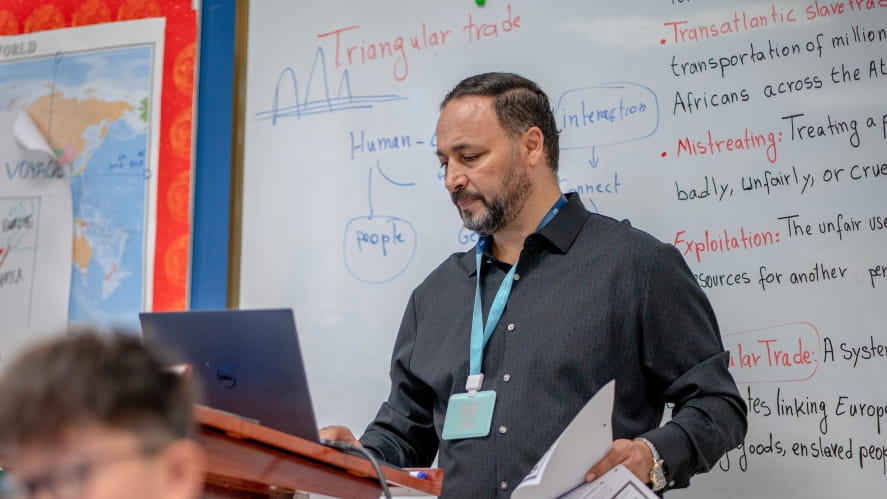
 AI in Our Classrooms: Teaching and Learning in the AI Era
Discover how DAIS teachers are exploring AI in the classroom through professional development focused on future-ready learning.
News image ![two boys on DAIS campus]() Blog | Whole school
Blog | Whole school
 Blog | Whole school
 What Is 5-Day Boarding? Current Students Can Try It with Buddy Up
Explore 5-day boarding at DAIS and see how students balance study, activities, friendships, and everyday life in the boarding community.