27 October, 2026
Supporting Every Learner: DAIS EAL Curriculum Has Been Fully Upgraded


Learning English is not simply about mastering vocabulary and grammar. The ultimate goal is to help students learn, think, communicate, and connect with the world confidently in English.
Since becoming a Cambridge English Demonstration School in September 2025, DAIS has continued to enhance its English as an Additional Language (EAL) curriculum, offering clearer learning pathways for students with different language backgrounds, ages, and goals. We firmly believe: Every child deserves a learning pathway that fits them.
One Standard to Guide Every Step of Growth
The school uses the CEFR (the Common European Framework of Reference for Languages) as a unified benchmark for English proficiency, tracking students’ development across listening, speaking, reading, and writing.
Placement and support are also informed by:
- WIDA language assessments
- MAP results
- Classroom performance
- Teacher observations
A student’s learning pathway is therefore not determined by one test alone, but by continuous assessment and their actual learning needs.
The goal is shared; the pathway is personalized.

Elementary School: Learning and Thinking in an Immersive English Environment
The DAIS elementary school curriculum is jointly developed by international teachers using globally recognized learning principles and the Cambridge English framework.
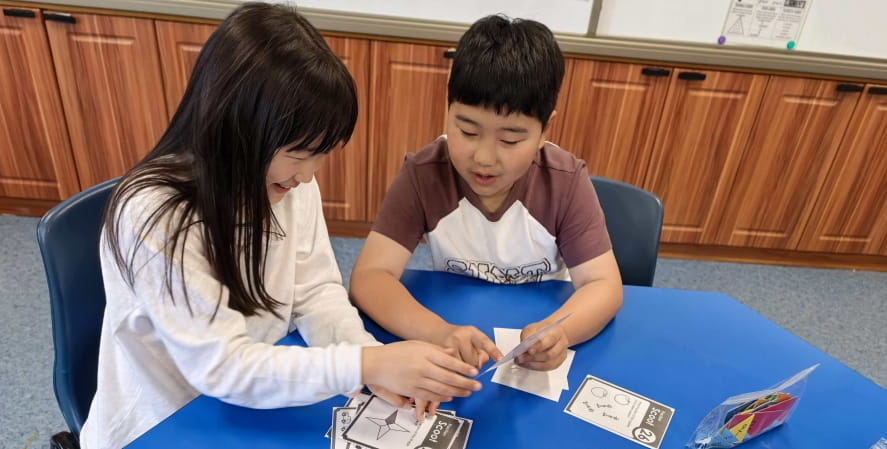
Lessons are delivered in English through project-based, inquiry-based, and collaborative learning. Students do not simply study English—they use it to acquire knowledge, express ideas, collaborate, and solve problems.
Our curriculum develops English thinking skills, intercultural understanding, and interdisciplinary learning abilities, preparing students for future international academic pathways.
Secondary School: From Language Support to Academic Success
From Grades 6–12, students increasingly use English to study mathematics, science, humanities, and other subjects. Their language development therefore moves beyond everyday communication towards academic application.
Based on WIDA results, MAP data, and teacher observations, students follow one of three development stages:
Emerging | Building Foundations
Students develop essential vocabulary, sentence structures, listening comprehension, and basic communication skills.
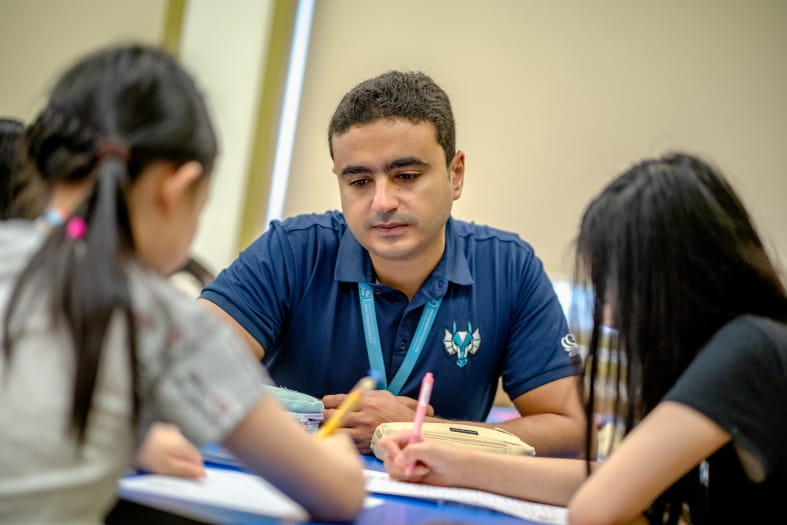
Visual resources, real-life contexts, teacher modelling, and collaborative activities help reduce language anxiety and build confidence in an English-learning environment.
Developing | Strengthening Academic Language
Students strengthen academic vocabulary, reading, writing, and classroom discussion skills.
They gradually move from everyday English towards the formal language required for subject learning, developing the ability to explain, compare, analyse, and express ideas.
Proficient | Advancing Academic English
Students develop higher-level skills in complex text analysis, argument construction, academic vocabulary, and advanced writing.
The program prepares them for college-preparatory courses, international assessments, and increasingly challenging academic study.
Placement Is Not a Label — It Is a Dynamic Pathway
Students are not permanently placed at one level.
The school continuously reviews assessment results, classroom performance, and individual progress, adjusting the type and level of support when needed.
As students become more proficient, they gradually rely less on specialised language support and participate more independently in mainstream academic learning.

From Classroom Learning to International Certification
The school also offers the Cambridge English Program for students in Grades 1–7. Small-group classes are differentiated according to CEFR proficiency levels and systematically strengthen listening, speaking, reading, and writing.
The program also provides a progressive pathway towards internationally recognized Cambridge English qualifications.
Every Child Deserves Their Own Pathway
Some students need stronger foundations. Some need additional language support. Others are ready for greater academic challenges.
At DAIS, we use one international standard to recognise progress while offering multiple pathways that respect individual differences.
Would you like to better understand your child’s current English level, suitable curriculum options, and future development pathway? Contact our Admissions Team to arrange a campus visit or a one-to-one consultation and discover the pathway that best supports your child’s growth.
Related news
News image ![Elementary students in the classroom]() News | Elementary
 News | Elementary
DAIS Elementary Celebrates Excellent NWEA MAP Results
Science averages were above the regional China comparison in every assessed grade, while Grade 4 performed above that comparison across all four subjects.
News image ![Saturday school]() News | Whole school
 News | Whole school
DAIS Saturday School 2026: Registration Is Open
From early learning and English development to exam preparation, robotics, science and business, Saturday School offers focused learning beyond the regular school week.